



Osteochondrosis of the lumbar region is accompanied by damage to the articular cartilage and bone tissue.
This disease affects people who, depending on their profession or lifestyle, are inactive.It is inactivity that causes the intervertebral discs to lose elasticity and mobility and after some time they become deformed and worn out.
The result of this deformation is a decrease in the distance between the vertebrae, and the nerve endings located between them are pinched.
This fact leads to pain.
Who is susceptible to this disease
Upon reaching age 30, few people can say they haven't had back pain.With age, this unpleasant manifestation only worsens.Compared to all known cases of osteochondrosis, osteochondrosis of the lumbar region occupies almost 90%.If the disease is not treated in the early stages, when gymnastics can alleviate unwanted consequences, the disease can be neglected.
Causes of lumbar osteochondrosis
Osteochondrosis of the lumbar region appears as a result of improper load on the spinal organ.There are enough reasons why this disease progresses:
- The presence of congenital defects in this area;
- Changes and violations of hormonal balance;
- Posture distortion;
- Low physical activity;
- Traumatic injuries;
- Chemical exposure;
- Hypothermia;
- Frequent lifting of weights in spurts;
- Increased nervousness;
- The presence of infections in the body;
- Overweight;
- Flat feet;
- Hypothermia.
Heredity also plays a significant role in the appearance of osteochondrosis.Having relatives suffering from this disease, it is necessary to take preventive measures more seriously.
Lumbar osteochondrosis has its own symptoms
Lumbar osteochondrosis, the symptoms of which consist of various pains and tensions of a certain muscle group.The pain felt by this disease is not the same.A distinction is made between aching, sudden and sharp, stabbing or burning pain.Increased pain occurs when making sudden movements, coughing and sneezing, or lifting heavy objects.
Osteochondrosis of the lumbar region, along with pain, is characterized by nausea, vomiting, headache and dizziness.With osteochondrosis of the lumbar region, symptoms such as dizziness, double vision, dysfunction of the urethra and functioning of the genitals are possible.
Due to the abundance of symptoms, osteochondrosis of the lumbosacral region is very difficult to miss.And if even some of the listed symptoms are detected, you need to go to the hospital.
How can osteochondrosis be treated?
Treatment of lumbar osteochondrosis can be carried out in several ways.The choice of method depends on the degree of development of the disease.
Stages of the disease:
- In the first stage, lumbar osteochondrosis begins with a dull pain in the lumbar region when lifting heavy loads.At this time, the intervertebral discs are damaged.
- In the second stage of development of osteochondrosis, the intervertebral distance decreases and the fibrous ring is destroyed.It is during this period that the nerve endings are pinched.This procedure is very painful for the lower back.The painful reaction from the lumbosacral region radiates to the thigh, buttock region and lower leg.
- In the third stage of development of osteochondrosis, the destruction of fibrous rings is observed.It is at this moment that the formation of intervertebral hernias begins.This phase of the disease is characterized by intense and constant pain.
- In the fourth stage, due to severe deformation of the spine, it becomes very difficult for the patient to move.The pain becomes constant, but even rare intervals without it do not please the patient.The disease in this form can lead to disability.
The second stage attack is accompanied, in addition to pain, by increased sweating and "goosebumps" on the skin.The duration of each subsequent attack increases compared to the previous one.
Osteochondrosis of the lumbar region can be treated with or without surgery.Operations for the treatment of osteochondrosis are performed in every tenth case.In other cases, complex treatment is used.There are four known ways to treat lumbar osteochondrosis non-surgically:
- Treatment with drugs;
- Therapeutic gymnastics exercises;
- Treatment with leeches;
- Massage and acupuncture.
Treatment of lumbar osteochondrosis with drug therapy begins with a medical examination.Based on the results of computed tomography, X-ray and magnetic resonance therapy, the doctor prescribes treatment.In many cases, the list of medications includes painkillers, anti-inflammatory drugs, muscle relaxants, and stimulants.
Starting from the third stage of the disease, it is possible to cure osteochondrosis of the lumbar region using the surgical method.Here you will have to use all the internal resources of the body.For this purpose, a gentle spinal stretching technique is used in combination with foot reflexology, massage, acupressure techniques and special exercises.
Gymnastic exercises for osteochondrosis
- Stay on the bar for just over a minute;
- The body tilts in different directions for up to 10 exercises;
- Movement of the pelvis forward and backward;
- Standing on all fours with arms outstretched, bend your back up and down 15 times;
- Ride an imaginary bicycle while lying on your back;
- Lying on your back, press and stretch your legs alternately 15 times;
- Push-ups 10-15 repetitions;
- While kneeling with your arms stretched out on the ground, bend your body in half and return to the starting position.
By performing this type of exercise daily, you can not only prevent the onset of osteochondrosis, but also reduce the symptoms of this disease.
When you walk, you need to pay attention to your posture.The correct posture involves keeping your head on the same vertical line with your back.At this time, the shoulders are in a straightened state, which will ensure a flat surface of the back without protruding shoulder blades.A tucked stomach will allow your chest to move forward.All these comments must be constantly implemented to avoid the development of osteochondrosis.
How to treat osteochondrosis without drugs
Treatment with folk remedies can relieve the symptoms of the disease and reduce pain, but does not cure the existing disease.Along with the treatment prescribed by the doctor, folk remedies can be useful, but they should not be taken as the basis of treatment.
Among the non-drug treatments of lumbar osteochondrosis, it is worth highlighting:
- manual therapy;
- massage;
- physiotherapy;
- acupuncture;
- apitherapy.
With the help of manual therapy it is possible to determine the cause of the disease and prevent its development.In addition, a manual doctor is able to relieve pain attacks.Manual therapy is vaguely reminiscent of massage, since the chiropractor's area of influence is the back and he works with the help of the hands.
However, massage actions are designed for muscle tissue, but manual therapy affects the vertebrae and ligaments.And this impact is carried out with some effort.The main thing here is to correctly calculate the force.This is why the qualifications and experience of a chiropractor are important.
Physiotherapy is very multifaceted.In a specific case it is necessary to use the amplipulse.This type of physiotherapy, when the painful area is affected using sinusoidally modulated currents.Using this procedure an analgesic, neuromyostimulant, trophic and vasodilatory effect can be obtained.
The second physical procedure that can trigger the regeneration process, reduce pain and eliminate inflammation is UHF therapy.Its action is based on a very high frequency magnetic field.
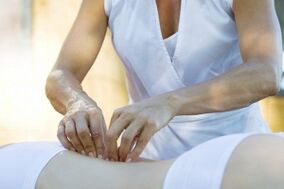
Massage procedures for osteochondrosis of the lumbosacral spine are based on the use of a unique massage technique, when simple stroking, squeezing and kneading is preferred.
Also, to treat osteochondrosis of the lumbar spine with massage, light shaking and rubbing of the surface of the back is allowed.
Massage actions are performed with the patient in the supine position.For massage, preference is given to hard surfaces.
In this case, a small pillow or pillow is placed under the stomach.At this time your shins should be raised 45 degrees.The position of the head at this stage should be below the level of the sofa, but not free floating, but resting on the support.
To achieve the best massage effect, it is carried out with heating agents.It is possible to carry out massage actions after thermal procedures.
Acupuncture refers to reflexology methods and allows the patient to relieve muscle spasms and increase blood flow in the tissues.The Kuznetsov applicator can also be classified as reflexology.It is applied to the sore spot.The duration of the session on this applicator does not exceed 20 minutes.Lying on a thorny mat for 5 minutes every day can relieve pain and relax tight muscles.This home doctor is sold in pharmacies at reasonable prices.
Osteochondrosis is treated by affecting 5-7 active points located on the human body.This procedure is performed by a qualified neurologist.
Apitherapy is accompanied by treatment with bee stings.The bites are placed on active points of the spine and resemble acupuncture.Bee venom can warm and relieve inflammation, eliminate pain and improve joint mobility.Bee venom has a tonic effect and is characterized by its long-lasting and persistent effect.
As folk remedies for the treatment of osteochondrosis of the lumbosacral region, the following are distinguished:
- rubbing with bee venom
- formic alcohol
- apply pepper patch.
If you want to use folk remedies, it is important to get your doctor's approval in this regard.
Acute back pain can be relieved by:
- propolis plates;
- wax compresses;
- honey compresses with aloe juice;
- honey poultices.
Diet as prevention of osteochondrosis
Preventive measures for lumbar osteochondrosis do not require a strict diet.Particular attention in nutrition is paid to dairy products, fresh vegetables, herbs, fruits and fruit jelly.It is very useful to use olive oil and lemon juice in your diet.
Preference is given to purified mineral water for drinking.And as second courses, it is necessary to eat protein products, jellied meat or jellied meat and sea fish as often as possible.In addition, food products for patients with osteochondrosis should contain as much calcium, vitamins A and D, B and C, magnesium and phosphorus as possible.
Products containing chondoprotectors are very useful for patients with lumbar osteochondrosis.Such products include animal cartilage in combination with sprouted wheat grains and other cereals.
Pregnancy is one of the reasons for the development of lumbosacral osteochondrosis.
Pregnant women in late pregnancy are at risk of developing osteochondrosis.Since the increased weight of the fetus contributes to the shift in the center of gravity of the body, creating an improper load on the lumbar region of the back.In combination with changes in metabolism and the lack of important vitamins and minerals, we get favorable conditions that contribute to the development of the disease.
Considering that the number of drugs and physiotherapeutic procedures at this stage is minimized, if osteochondrosis occurs in a pregnant woman, treatment should be prescribed and coordinated by doctors: a therapist and a gynecologist.
Harmless methods used to prevent osteochondrosis in a pregnant woman include special bandages and corsets, frequent walks, gymnastics for pregnant women and a specialized vitamin course.